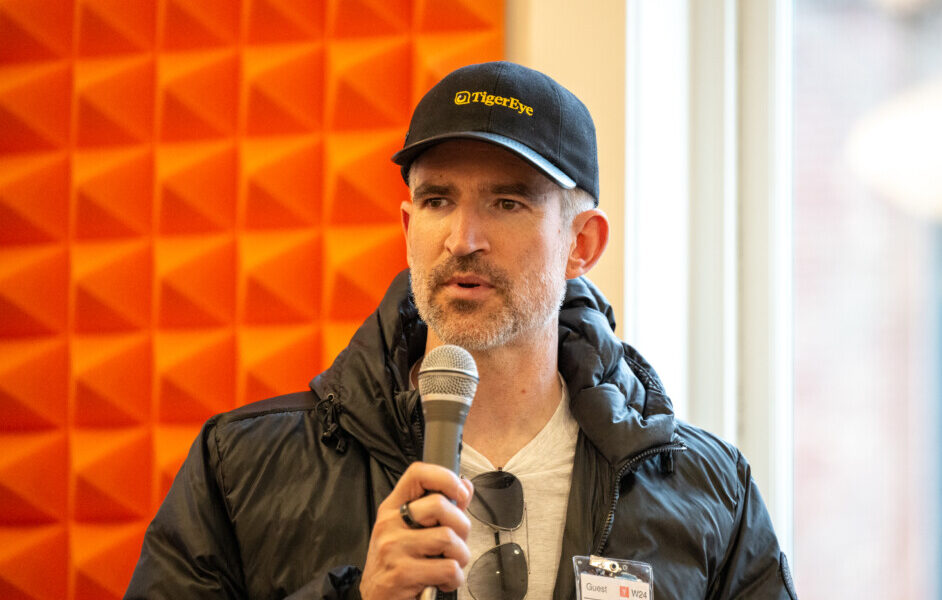
Ralph Gootee, CTO and Co-Founder at TigerEye, leads the event of a enterprise simulation platform designed to reinforce strategic decision-making, planning, and execution. By leveraging superior time-aware AI expertise, TigerEye allows organizations to streamline planning processes, simulate varied situations, and make data-driven choices extra effectively.
Based by Gootee and former PlanGrid executives, TigerEye addresses widespread challenges in enterprise planning, corresponding to outdated spreadsheets and extended planning cycles, with a deal with adaptability and predictable development. The platform integrates ideas from industries like building and software program QA to offer dynamic options that assist companies optimize operations and scale successfully.
What impressed you to start out TigerEye, and the way did your earlier experiences with PlanGrid affect your imaginative and prescient for the corporate?
I’ve at all times discovered knowledge to be a problem. Again after we constructed my final firm, PlanGrid, instruments like Looker and Redshift had been simply popping out. The idea of insights was new. Mixpanel and Amplitude had been nonetheless of their early days. These merchandise had been so contemporary that you just needed to construct your individual knowledge engineering group to deal with any type of knowledge insights.
At PlanGrid, we assembled an unbelievable group with PhDs and proficient leaders who did spectacular work: figuring out sizzling leads, analyzing buyer connections, and calculating ARR. But it surely took a 10-person group, was costly, and left analysts feeling like ticket crunchers, operating SQL queries to reply segmentation and development questions. After they ultimately moved on to steer knowledge science groups elsewhere, the remaining group was typically left struggling to make sense of the dashboards they left behind, resulting in important wasted time. Moreover, our CFO manually verified these numbers to make sure accuracy.
As a board member at different firms, I noticed the identical sample: disconnected dashboards that had been arduous to piece collectively into actionable insights. Through the Autodesk acquisition of PlanGrid, these challenges grew to become even clearer. Managing two Salesforce environments and coordinating primary back-office duties like CRM, ERP, and advertising and marketing was a battle. Even figuring out which campaigns had been working was a thriller. These frustrations impressed the imaginative and prescient for TigerEye: a option to make knowledge seamless, actionable, fast and accessible.
TigerEye provides a versatile AI answer for go-to-market groups. What challenges out there did you establish that led you to design a conversational AI for enterprise intelligence?
Go-to-market analytics typically really feel overwhelming as it’s full of numbers, stats, and heavy math. The method of asking artistic, investigative questions is clunky. You would possibly create a ticket for the info group, asking for one thing like a win fee graph. There’s back-and-forth clarification, delays, and generally you understand you requested the flawed query. For most individuals, it’s neither an satisfying nor a quick course of particularly for these with out the authority of a C-Suite government to fast-track responses.
Conversational AI modifications that. Think about simply saying, “Present me win charges for the West Coast in pink versus the East Coast in brown, over the previous 4 quarters, in a bar chart.” A dialog like that takes seconds and so does the output. We designed TigerEye to present customers an intuitive “junior analyst” they’ll discuss to — at all times out there to create insights with out the necessity for a clunky interface.
What had been essentially the most important hurdles you confronted throughout the early phases of TigerEye’s improvement, and the way did you overcome them?
One main shock was the sheer scale of knowledge we encountered, no matter firm dimension. Even mid-market firms typically have huge quantities of knowledge that change steadily. Present instruments like Looker couldn’t deal with these workloads effectively; we noticed load instances of 10–12 seconds for a single graph. That’s unacceptable for immediately’s fast-paced enterprise atmosphere.
To deal with this, we needed to innovate. We built-in DuckDB for quicker question execution and selected Flutter for constructing a light-weight, environment friendly interface. Moreover, we contributed again to the open-source group by creating and sustaining DuckDB.Dart, enabling seamless integration with Dart and Flutter environments. These applied sciences allowed us to optimize for velocity, flexibility and scalability.
As a co-founder, how did you and your group prioritize options and capabilities for TigerEye’s launch?
We began by placing your complete firm’s sources behind the AI Analyst imaginative and prescient. This meant each front-end and back-end engineer contributed. The character of an AI analyst required a full-company effort as a result of it’s not nearly textual content output; it’s about offering interactive widgets, configuring simulators, and enabling analysts to take significant motion. For instance, one characteristic lets customers configure a future plan so as to add 10 reps to the West Coast seamlessly, which entails designing a extremely interactive and intuitive system.
The event course of had its ups and downs, however the technical spine was constructed on rigorous analysis. This grew to become the core of our prioritization. Analysis is the place the actual work occurs. We’re always asking, “Did this modification make the system higher or worse?” We began with our engineering group and our area specialists and ultimately developed to capturing buyer inquiries to refine our system additional.
We launched an automatic check suite the place the AI evaluates itself and assigns a rating to find out if modifications are enhancements. To make sure accuracy, we nonetheless conduct human evaluations weekly to stop biases like an LLM giving itself prime marks. This dual-layer strategy has been essential to getting TigerEye to a “1.0” state and regularly elevating the bar.
Lastly, attaining domain-specific alignment was a serious focus. Gross sales and go-to-market operations demand exact, specialised solutions, and alignment throughout stakeholders isn’t at all times simple. For this reason area experience and real-world buyer suggestions had been essential in shaping TigerEye into the platform it’s immediately.
How does TigerEye’s strategy differ from conventional BI instruments, and what affect has this had on adoption charges amongst companies?
TigerEye was constructed from the bottom up with AI and cell, providing an answer that’s inherently moveable and designed to reply questions shortly. Not like conventional BI instruments, that are gradual and infrequently require intensive configuration, TigerEye prioritizes velocity and ease of use by means of conversational AI.
Our graphs and widgets are extremely versatile, with interactive visuals that enable customers to discover knowledge intuitively. The AI doesn’t depend on generic, surface-level info that may result in inaccurate responses; as a substitute, it’s specialised to ship exact, structured metrics tailor-made to every enterprise.
Whether or not for startups, midmarket, or enterprise firms, TigerEye ensures consistency by grounding all calculations in SQL, enabling each front-end and AI-driven queries to ship the identical dependable numbers. We additionally present transparency by exhibiting prospects the mathematics behind our evaluation, guaranteeing they perceive precisely how the TigerEye platform arrived at its responses. This dedication to readability helps construct belief and confidence within the insights delivered.
The result’s an AI platform that delivers robust customizability whereas empowering groups to entry actionable insights independently, permitting knowledge groups to deal with extra strategic duties. This strategy has accelerated adoption amongst companies in search of intuitive, scalable, and exact instruments to reinforce their decision-making.
How does TigerEye leverage AI to adapt and study from CRM, ERP, and advertising and marketing automation modifications in actual time?
TigerEye makes use of AI, together with Retrieval-Augmented Era (RAG) and integrations with real-time APIs, to adapt dynamically to modifications in CRM, ERP, and advertising and marketing automation platforms. We additionally mix GenAI with extra conventional machine studying and simulation principle to present our AI the power to foretell the longer term. By connecting immediately to those methods, our firm repeatedly displays updates, corresponding to new buyer data, modifications in deal phases, or marketing campaign efficiency metrics, guaranteeing insights stay present and actionable.
Our AI Analyst doesn’t simply passively report knowledge; it learns and evolves with buyer workflows. For instance, if a gross sales group modifies its pipeline construction, TigerEye shortly identifies the modifications and adjusts its calculations, forecasts, and suggestions accordingly. This real-time adaptability eliminates guide updates and ensures management and groups at all times have an correct, up-to-date view of their go-to-market efficiency.
Additionally, TigerEye’s flexibility permits it to work throughout a number of methods, guaranteeing seamless integration and alignment. Whether or not it’s Salesforce, HubSpot, NetSuite, or different platforms, TigerEye’s AI allows groups to chop by means of complexity, delivering well timed, dependable insights that drive smarter, quicker decision-making.
With rising complexity in go-to-market operations, how does TigerEye simplify decision-making for management and groups?
Actionable insights by means of conversational AI. Conventional BI instruments typically require groups to navigate cumbersome dashboards, look ahead to knowledge groups to generate stories, or manually piece collectively metrics throughout siloed methods. TigerEye eliminates these bottlenecks by offering prompt, AI-driven solutions tailor-made to management and groups’ wants.
Our AI Analyst capabilities like a proactive, junior group member, able to responding to questions corresponding to, “What’s my win fee in This autumn throughout areas?” or “How would including 5 reps to the East Coast affect ARR?” The platform delivers insights in seconds with out the necessity for knowledge modeling or intensive setup.
By integrating AI with tailor-made enterprise intelligence, TigerEye ensures that each one metrics are correct, constant, and aligned throughout the group. Management positive factors readability on strategic choices, whereas groups profit from instruments that floor tendencies, predict outcomes, and cut back the noise of operational complexity. TigerEye helps enterprise leaders make quicker, smarter choices with out the heavy elevate.
How do you see conversational AI reworking enterprise intelligence over the following 5 years?
Enterprise intelligence is at present at a crossroads. Many instruments stay caught in an older or acquired state. They’re gradual to innovate, missing new merchandise, and overly generalist of their strategy. These legacy options weren’t constructed from the bottom as much as combine with giant language fashions or to supply AI interoperability. Normally, they’re attempting to retrofit outdated methods with unproven AI options, which isn’t transferring the needle.
Conversational AI will drive a brand new breed of specialised BI purposes. These instruments gained’t require groups to spend numerous hours customizing and constructing options — they’ll be tailor-made from the outset to deal with particular wants in finance, gross sales, advertising and marketing, building, oil and fuel, and different industries. Every market is evolving otherwise, and specialization is essential.
Foundational AI fashions like OpenAI, Anthropic, and Mistral will proceed to deal with broad, generic purposes, however the way forward for BI lies in specialised vertical options that tackle distinctive issues. Specialised AI instruments for BI will substitute the present one-size-fits-all strategy, enabling companies to extract insights quicker and extra precisely. It might ship precision and actionable insights inside its area. This shift will redefine BI as we all know it.
After serving as a visiting associate at Y Combinator, how has mentoring startups influenced your management type or strategy to innovation?
YC taught me the significance of prioritizing individuals. I realized to focus my power on founders who had been hungry, open to suggestions, and relentlessly tenacious. These traits — grit and adaptableness — are hallmarks of profitable groups, and I’ve carried that into TigerEye.
One other lesson was recognizing the worth of range, each in thought and background. At YC, I noticed firsthand how founders from underrepresented teams typically introduced unbelievable resilience and creativity to the desk. It’s a perspective that’s formed how we construct and lead at TigerEye immediately. Variety strengthens groups and drives innovation.
What’s your imaginative and prescient for the way forward for TigerEye, and the way do you intend to broaden its affect throughout industries?
TigerEye is at first an AI firm. Our purpose is to carry the improvements we see in shopper AI, just like the seamless interplay in instruments like Perplexity and Cursor, into the enterprise. Think about a private assistant that you could ask for insights wherever, on any gadget. Have to know why offers stalled in Q2 or what could be required so that you can double your gross sales headcount in a sure area whilst you’re on the transfer? You ask, and it’s there immediately, correct and constant throughout the corporate.
The way forward for TigerEye is about simplifying entry to knowledge and making insights ubiquitous, whether or not you’re utilizing a cell app, sporting a smartwatch, or asking for a report in Slack. We’re centered on creating instruments that make data-driven decision-making easy.
Thanks for the good interview, readers who want to study extra ought to go to TigerEye.